
Chip Stocks Under Pressure: Why Micron, Nvidia, AMD and Broadcom Are Dragging the Nasdaq Lower
The S&P 500 sits near record highs, but chipmakers led by Micron are pulling the Nasdaq lower. Chinese memory competition, high bond yields and sky-high AI expectations are prompting investors to lock in profits.

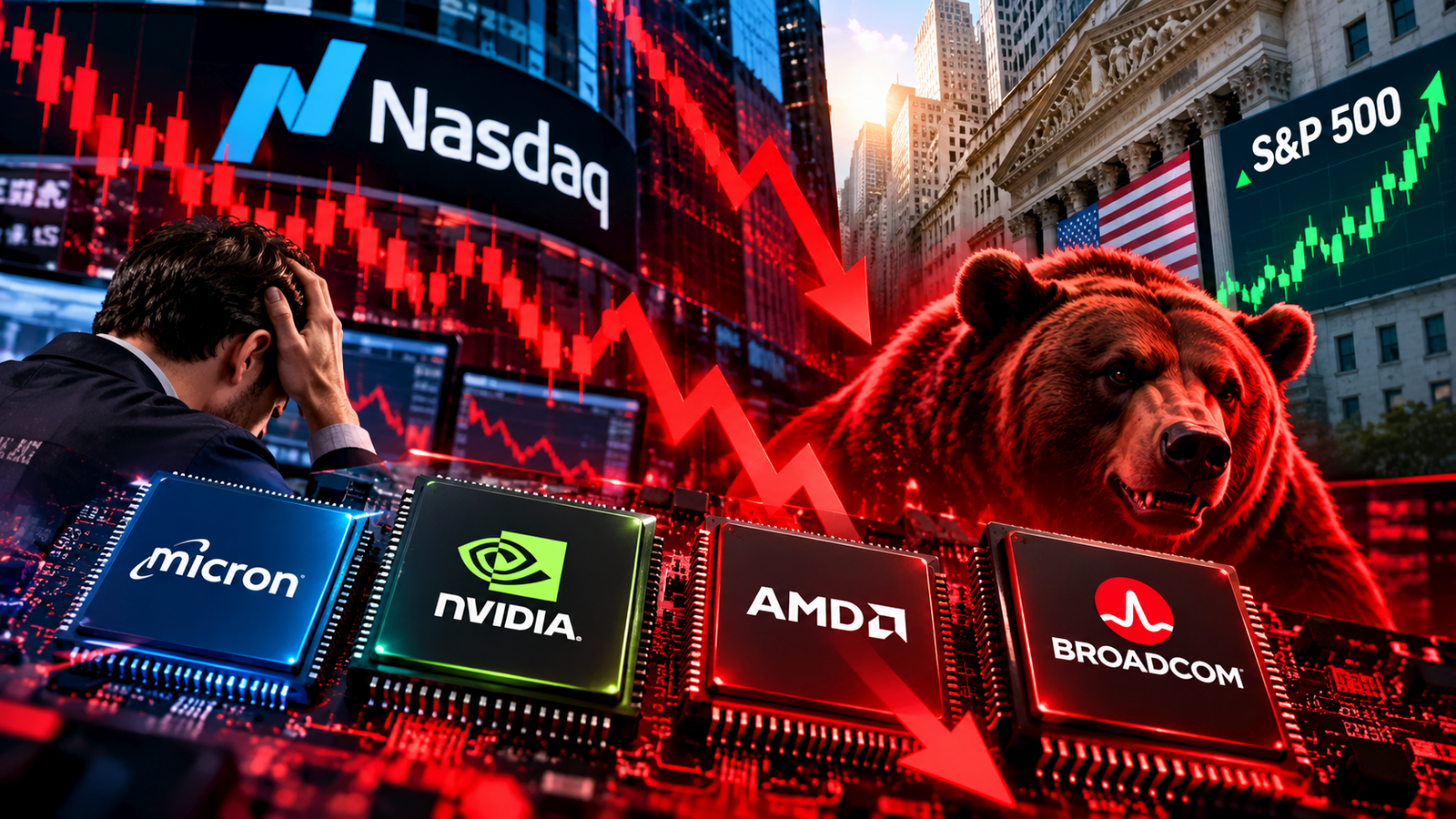
Wall Street is sending a mixed message. The S&P 500 and the Nasdaq Composite both set record highs last week, yet the stocks that powered the AI rally are suddenly the ones holding the market back. On Monday, October 12, the Dow Jones Industrial Average rose 0.38% to 51,850.55, while the S&P 500 slipped 0.06% to 7,807.24 and the Nasdaq fell 0.44% to 27,245.90. Semiconductors were the main drag.
This is not a crash. It is something more subtle: a market that still believes in artificial intelligence but is no longer willing to pay any price for it.
Micron: From Market Darling to Pressure Point
Memory maker Micron Technology (MU) fell about 3.9% on Monday to close near $989. The trigger came from China, where memory producer CXMT announced progress on a new chip design. South Korea’s SK Hynix and Samsung Electronics also came under pressure.
Context matters here. Micron is up roughly 400% this year and now carries a market value close to $1.2 trillion. When a stock has run that far, even modest competitive news can spark heavy profit-taking. The worry is straightforward: AI servers need enormous amounts of high-bandwidth memory, and that demand has given Micron and its Korean rivals rare pricing power. If Chinese suppliers close the technology gap faster than expected, that pricing power could erode.
Nvidia, Broadcom and AMD: Valuation Fatigue
Nvidia (NVDA) slipped about 1.3% to around $226, still valued at more than $5 trillion. Broadcom (AVGO) dropped roughly 1.9% to near $355, leaving it essentially flat for the year despite the AI boom. Advanced Micro Devices (AMD), one of the most volatile names in the group, has also swung sharply in recent months after a huge first-half run.
Meanwhile, money moved elsewhere inside big tech. Apple, Microsoft and Meta Platforms all closed higher on Monday, suggesting investors are rotating within technology rather than abandoning it.
A Year of Sharp Swings
Monday’s pullback fits a pattern that has defined 2026 for chip stocks:
June: Broadcom issued an AI revenue outlook that disappointed investors and declined to raise its full-year guidance. Combined with a stronger-than-expected jobs report that lifted rate-hike fears, the chip sector lost more than $1 trillion in market value in a single session.
July: Concerns about hyperscalers’ enormous AI spending and China’s push into memory and lithography equipment pushed chip stocks into bear-market territory, more than 20% below their highs.
August: Treasury yields climbed to their highest levels since 2007, hitting expensive growth stocks hard.
September–October: A strong recovery carried the Nasdaq to four straight weekly gains and new records, setting the stage for the current round of profit-taking.
Why Higher Rates Hurt Chip Stocks Most
Semiconductor companies are valued largely on profits expected years into the future. When interest rates rise, those future profits are worth less in today’s money. With the 10-year Treasury yield near 5.3% and the Federal Reserve having raised rates in September, investors are applying a harsher discount to long-term growth stories. That is why chip stocks often fall hardest on days when inflation fears or bond yields jump.
The AI Capex Question
The bigger debate is about spending. Tech giants are pouring hundreds of billions of dollars into data centers, and chipmakers are the direct beneficiaries. As long as that spending keeps growing, the bull case holds. But expectations are now so high that even strong results can disappoint. Investors increasingly want evidence that AI investments are generating real returns for the companies making them, not just revenue for the companies supplying the hardware.
NXT Media View
The current pullback looks more like tactical profit-taking than a collapse in the AI story. Demand for AI computing remains strong, and the broader market sits near record levels. Still, three risks deserve attention: competition from Chinese memory makers, any sign of slowing data-center budgets, and a hot inflation reading this week that could push yields higher. Upcoming results from major chip suppliers will be the next real test. Volatility in this sector is likely to stay high, so position sizing and patience matter more than usual.
Frequently Asked Questions
Why did Micron stock fall on October 12, 2026?
Micron fell nearly 4% after Chinese memory maker CXMT reported progress on a new chip design, raising concerns about future competition and pricing pressure in the memory market. The stock’s huge gains this year also made it vulnerable to profit-taking.
Is the AI chip rally over?
Not necessarily. The S&P 500 and Nasdaq both hit record highs last week. The recent decline reflects valuation concerns and profit-taking rather than a clear drop in AI demand, though the sector remains highly volatile.
Why do rising interest rates affect tech stocks?
Tech and chip companies are valued on expected future earnings. Higher interest rates reduce the present value of those future profits, which tends to lower the prices investors are willing to pay.
What is high-bandwidth memory (HBM)?
HBM is a type of fast, stacked memory chip used alongside AI processors such as Nvidia’s GPUs. It is essential for training and running large AI models, and demand for it has driven strong profits at Micron, SK Hynix and Samsung.
What is the Philadelphia Semiconductor Index (SOX)?
The SOX tracks 30 major US-listed chip companies, including Nvidia, Broadcom, AMD, Micron and TSMC. It is the most widely watched benchmark for the semiconductor sector.
How does a US chip selloff affect Indian investors?
Indian investors with exposure to US tech through international mutual funds or ETFs feel the impact directly. Weakness in global tech can also influence sentiment toward Indian IT and electronics manufacturing stocks.
Disclaimer: This article is for informational purposes only and is not investment advice. Stock prices referenced are approximate closing levels as of October 12, 2026. Readers should consult a qualified financial advisor before making investment decisions.